Monday, 26 May 2008

11 pelagic sharks listed as endangered

The IUCN has listed 11 pelagic sharks and rays as threatened with extinction. Pelagic species are traditionally seen as resilient, this study shatters this illusion


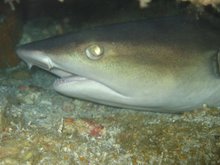
Grey reef shark. Not part of this study but also increasingly under pressure from overfishing


Fuller story can be found
Click HERE

Thursday, 20 March 2008

We should all reduce waste

This video clip, about reducing our individual wasteful habits, will at first sight seem not related to marine conservation issues. However the huge amounts of plastics and waste thrown into the worlds oceans has a direct and catastrophic effect on the worlds oceans. Plastics are consumed in error and kill multitudes of wild animals. Watch out for the horrific image of the dead bird with its stomach full of discarded cigarette lighters.

Reduction of waste is vital, and not just for reducing the number and size of landfills..

Thursday, 6 March 2008

now and then - fishy business

Interesting article in the SCMP last Sunday about the fishing industry in Hong Kong. Details can be found on the livingseas website. by clicking here:

Click here

Thursday, 21 February 2008

WWF SOS video

This is worth a watch

Tuesday, 12 February 2008

Use of Shark products in cosmetics

In an article titled "Unilever ends the use of shark products in its cosmetics" Oceana also point the way to consumers needing to be better informed of what osmetic firms are using in their cosmetics.

Quotation from Oceana
“Oceana is satisfied to see that some of the biggest names in the cosmetics industry are recognizing their corporate social responsibilities and choosing not to contribute to the extinction of these important animals,” said Rebecca Greenberg, a marine scientist with Oceana and coordinator of the shark campaign. “We encourage people to become educated and responsible consumers by asking cosmetic retailers about squalene sources and directing their purchases towards companies that have never used this animal-based product in cosmetics or that have made the decision to replace it.”

Actually I was completely ignorant of this use. But not anymore.

Full article can be found here.
http://www.oceana.org/europe/media/press-releases/press_release/0/746/

Monday, 10 December 2007

Cutting total catches increases profitability

Research is showing that fishermen will make even more profit than thought if they let stocks rebuild.

The simple reason is that when stocks are plentiful they become easier and cheaper to catch.

This is not rocket science but is a departure from traditional fisheries management, where the maximum highest sustainable catches are set so as to not deplete stocks.

The research shows that there would be higher profits if stocks were kept at a higher level.

"We calculate that we should be conserving about 65% of the virgin biomass whereas at the moment we're down to about 30%."
Source:BBC (Quentin Grafton, Australian National University,Canberra

This is good news for those of us that want to see marine biodiversity maintained.

The full report from the BBC can be found http://news.bbc.co.uk/2/hi/science/nature/7127761.stm

Thanks to Charlie for passing this on

WWF-HK starts a shark fin campaign

WWF Hong Kong has launched a shark fin campaign on the 3rd December, aimed at highlighting the
  1. Most shark fisheries are poorly managed and unsustainable.
  2. Huge wastage, 90-95% of the shark is disposed of after the fins are cut off.
  3. 20% of the 546 shark species on the IUCN redlist are threatened with extinction.

Consumers should stop eating shark fin and restaurants should stop selling it.

The full story can be found Click HERE

Thursday, 6 December 2007

Fish don't have many friends

This is so true...
we all love polar bears and tigers, flamingos and eagles but how many friends do fascinating fish have?

Thanks to Dr. Martin for passing me this.

Hong Kong marine species struggling to survive

A recent study and press release from WWF-Hong Kong highlights the plight of some of Hong Kong's favourite marine species, including the green turtle, horseshoe crab and chinese bahaba.

Also worth noting is :

"the dire situation facing the globally Critically Endangered Chinese Bahaba and locally depleted Hong Kong Grouper, both well-known edible fish in Hong Kong, were largely unknown to the general public. Mr Alex Fong, Ocean's 10 Ambassador of WWF Hong Kong said, "The polling results show charismatic marine species such as the Chinese white dolphin and Green turtle have received far greater public attention than commercially important fishes"

Sounds like a familiar story. There is a need to focus on better protection not only on individual species but the setup and real complete protection of a variety of marine habitats.

The story from WWF can be found here: http://www.wwf.org.hk/eng/pressreleases/20071115.php?source=eNews200711_1

Tuesday, 27 November 2007

Whaling starts again in earnest

The Japanese have been routinely slammed in the western press for increasing their planned hunts for whales this year and to include humpback whales for the first time in decades. Under the pretense of scientific research they are planning to kill more than 1000 whales.

"The fleet intends to kill more than 1,000 whales while in the Southern Ocean, including 50 endangered fin whales, 50 threatened humpback whales and 935 minke whales. " Source : Greenpeace

The slaughter of endangered fin and humpback whales is inexcusable. These species are IUCN listed, respectively as
  1. Endangered ("A taxon is Endangered when it is considered to be facing a very high risk of extinction in the wild" source: iucn.com) and
  2. Vunerable ("A taxon is Vulnerable when it is considered to be facing a high risk of extinction in the wild")
However in my opinion.
  • It would be better in many ways if we did not interfere with the natural world at all, however excluding human extinction this is not realistic or achievable and thus I have no real problem in sustainable fishing of a species, the current levels of hunting minke whales is sustainable
  • From a conservation perspective, the West's argument about species killing needs to be consistent, not just focused on high profile intelligent or cuddly animals
  • all species in the world have a right to live whether they are minke whales, napoleon wrasse, corals or ameoba
  • Inconsistent treatment confuses the conservation and species protection message, we should be focused on ensuring ecological balance, let the natural balance of life work its wonder.

Arguments?

Wednesday, 21 November 2007

Fish dumping will ruin industry (sic)

Interesting report on the BBC, sent to me by a good friend, this also made the BBC World Service and BBC News 24. The story is that Europeanfishermen are complaining that because they have already exceeded their fishing quota for various whitefish (cod, haddock and whiting) they have to through away significant quantities of valuable by-catch from allowed prawn trawling.

The report(s) can be found here:
http://news.bbc.co.uk/2/hi/uk_news/7103363.stm
http://news.bbc.co.uk/2/hi/uk_news/7102241.stm

The destruction and wastage is terrible and very very sad of course, but my believe is that the fishing industry is wholly responsible.

Here is my suggestions.
  1. European wide fishing quotas must remain and need to be strictly enforced based on scientific evidence.
  2. Fazing out of trawling within areas of high biodiversity, and introduction of penalities for their use.
  3. Investment into sustainable shrimp fishing and shrimp farming.
  4. Consumer education and labelling into the shrimp industry and the source for shrimps on supermarket shelfs.

The above should also be introduced into the Asia Pacific region as an urgent matter

Saturday, 10 November 2007

Fishing ban called for Bluefin tuna

WWF is calling for a three year closure of the fisheries industry in European waters. The timing of this proclaimation is aligned with the meeting of International Commission for the Conservation of Atlantic Tunas (ICCAT) — meeting from 9 to 18 November in Antalya, Turkey.

This is a follow up to an earlier blog on Bluefin Tuna, click here

Miracle if anything positive comes out of this ICCAT meeting, as there is a history of indecision.

This latest story can be found here:
http://www.panda.org/index.cfm?uNewsID=116941

Thursday, 8 November 2007

South East Asia's Oceans running out of fish

A new report from Australia's Lowy Institute spells out what we have all know for a long time, overfishing in South East Asia is depleting SE Asia's fish stocks and coral reefs. Source:Environmental News Network http://www.enn.com/top_stories/article/24297

Few quick points

  1. Fisheries in the region have expanded dramatically in the past few decades
  2. Thailand, Vietnam, Indonesia and Philippines are now inthe top 12 fish producing countries in the world.
  3. In the Gulf of Thailand, the density of fish had declined by 86 percent from 1961 to 1991, while between 1966 and 1994 the catch per hour in the Gulf by trawlers fell more than sevenfold.
  4. In the Gulf of Tonkin, where Vietnam shares resources with China, the record was even worse with fish catch per hour in 1997 only a quarter of that in 1985.
  5. In the Philippines, most marine fisheries were overexploited by the 1980s, with catch rates as low as 10 percent of rates when these areas were lightly fished.
  6. As the fourth largest country in world fish production, Indonesia is a fisheries giant. Yet ... Indonesian marine fisheries resources are close to fully exploited and a significant number in all areas are over-exploited.

Recommendations in the report include

  1. Help Southeast Asian countries build their capacity for fisheries management.
  2. The principle of stakeholder inclusion in its fisheries interventions by stressing the importance of including views from fishers’ representatives, environmental organisations, community and women’s interests, consumers and the private sector representing the retail, food service and fish processing sectors.
  3. Substantial increase in the amount of marine conservation research.
  4. Regional bodies such as APFIC, ASEAN and SEAFDEC need to create a regional process to assess fisheries resources and to provide advice to fisheries managers in a form suitable for local use.
  5. Consumer information, correct labelling of country and source of origin, in an effort to increase awareness of and pressure for sustainable fish products as well as combat illegal fishing.

Full report can be found on the Lowy Institute website as follows:
http://www.lowyinstitute.org/PublicationGet.asp?i=714

Monday, 29 October 2007

New nudibranch discovered in Hong Kong

Photo taken in Hong Kong waters by Charlie Frew. A previously undescribed species.

Click on the following link.
http://www.hkoutdoors.com/forums/activities/undescribed-nudibranch.html#962


There are hidden gems in the waters of Hong Kong. More work needs to be done to preserve it before it is too late.

Tuesday, 23 October 2007

Hoi Ha Wan - A marine park in Hong Kong

Hoi Ha Wan is one of four marine parks in Hong Kong. It is located in the North East of Hong Kong, geographically located in SaiKung, it is actually under TaiPo District council.

Under Hong Kong legislation marine parks are protected to some degree,the following picture, taken in Hoi Ha, indicates the activities not allowed :


The key points are that fishing is still permitted in the Marine Parks, to licensed fishermen and that the park is not adequately policed. On a visit during the weekend of the 20th October 2007, I found the following character right on the beach under Hoi Ha Wan village and a stones throw from the AFCD office.


Unfortunately at the time I took this photo I could not tell that he had a seastar in his hand, otherwise I might have spoken to him, as he walked away I could see that he had a nine inch long divers knife, strapped to his leg. One can only guess what he was looking for, however what ever is it he should not be doing it..

There is a growing disquiet in Hong Kong about inadequate protection of marine life AND about the lack of knowledge about the issues. All things marine are seen as inexhaustible.

Wednesday, 10 October 2007

Apo reef - fishing banned

Apo reef is a beautiful and relatively remote place, that compared to many other parts of the Philippines is relatively unpopulated, however significant parts of the reef have still suffered from some serious abuse through over fishing together with destructive fishing techniques. I have been to Apo reef twice in 1994 and 2002 and did enjoyed some good diving on some of the dive sites.

Apo Reef (note: not the similarly named Apo Island, a marine reserve off Negros Island in the Southern Philippines) located off the west coast of Mindoro in the Philippines is trying to relive "old glories" and has put into place a total ban from 2nd October on "all extractive activities such as fishing, collection and harvesting of any life form"

Full article, courtesy of WWF-Philippines can be found HERE

One of the key problems with setting up these kinds of No-Take reserves is resistance from the local fishing community, to overcome this alternative sources for fishing have been developed, through installation of overshore fish aggregation devices. A local solution to the local situation, resistance will persist, but hopefully with increased fish aggregations and increased tourism, the project will be successful.

A worthwhile project to support and I hope to visit sometime soon.

Monday, 8 October 2007

The Harm of Good Intentions - turtles

Came across an interesting argument and perspective on the issue of keeping turtle hatchlings and releasing them until they are stronger.

The argument of this article posted on the WWF Philippines blog puts forward a compelling argument as to why turtle hatchlings should be left and not collected, fattened up and then release later. Essentially the argument is as follows:
  1. Within the first 24 hours of life turtle instinct is to go out beyond the surf zone to catch major currents. They are carried to development areas where they remain until strong enough to migrate distances, it is during this period that the turtles learn about the currents and their migration routes. Key to their survival.

  2. The turtles reproduction process has proven very successful, without human intervention and has enabled the turtles to out live the dinosaurs.

Obviously turtles need a helping hand when human interference is affecting the survival, such as egg collection or fishing by catch but other than that, maybe we should leave them alone...?

Are they right..?

Full article can be found here:
http://newsfromkkp.blogspirit.com/archive/2006/03/21/the-harm-of-good-intentions.html

Sunday, 23 September 2007

Shrimp/prawn farming - the bad news in detail

I have known for a while that eating prawns are bad and should be avoided (see other posts on this blog) Prawns/shrimp are either caught using highly destructive trawling or farmed using methods that are highly destructive to marine and coastal ecological systems.

The following two links provide some more information and are interesting reading.

Hungry for change: EJ Foundation campaign for ethical shrimp (read prawn) farming and fisheries: click here

Details report into the shrimp industry : click here


The conclusion of the executive summary section of the "...costing the earth" report says:
"Immediate action is necessary by all stakeholders and specifically governments, the shrimp farming industry, seafood producers, traders and retailers plus aid and development agencies, which together are promoting or indirectly supporting the unsustainable and unethical practices of this industry."

The consumer guide references a need to be aware of what you are eating, ask the right questions of the restaurants and supermarkets and only buy ethically produced prawns.

Now that is the challenge. I don't see any labels or information to help consumers in this regard, maybe if we started to ask then this will start to happen.

Thursday, 20 September 2007

EU closed Bluefin tuna fisheries for the rest of 2007

Due to the reaching of quotas for the year. This affects Cyprus, France, Greece, Italy, Malta, Portugal and Spain. The European Union Fisheries Common fisheries policy set a target to ensure the long term survival of tuna. This includes reducing the amount caught, banning the use of spotter planes and ensuring fish smaller than 30Kgs are returned to the sea. Fisheries policy in the EU has not been very successful in the past but hopefully this will be adhered to and successful.

There are three bluefin tuna species, all provide the highly prized flesh for sushi and shashimi in Japanese restaurants worlwide. All species are critically endangered due to overfishing.
Northern bluefin tuna (Thunnus thynnus)
Southern bluefin tuna (Thunnus maccoyii)
Pacific bluefin tuna (Thunnus orientalis)

We should all reduce consumption of this fish. See the seafood guides for more information:
Click here for the seafood guides


Press release for the closure of the fisheries for 2007 :
http://ec.europa.eu/fisheries/press_corner/press_releases/com07_60_en.htm

Press release regarding sustainable fisheries for the bluefin tuna
http://ec.europa.eu/fisheries/press_corner/press_releases/archives/com06/com06_88_en.htm

Monday, 17 September 2007

Malaysian ministry bans shark's fin soup

Just received this:

"Ministry bans shark's fin soup - Malaysiakini.com ( http://malaysiakini.com/ ) Sep 15, 07 4:16am

Malaysia's Natural Resources and Environment Ministry has struck off shark's fin soup from the menus at official functions, to help conserve the species, a report said today.

Minister Azmi Khalid told the official Bernama news agency that the ministry had made the commitment to the Malaysian Nature Society.

"By refraining from the consumption of shark's fin soup, it is hoped that the ministry would contribute in one way or another towards the current conservation efforts for sharks species," he said.

"Their demise would start off a domino effect, which at each stage could result in the depletion or overpopulation of other fish and marine species leading to an imbalance in the marine ecosystem," he said.

On preservation drive

The society's Selangor branch Marine Group is on a drive to encourage individuals and organisations to stop serving the delicacy at corporate functions.
The marine group had embarked on a series of activities and programmes to promote awareness on the plight of sharks and their importance to the marine ecosystem.

Malaysia's population is dominated by Muslim Malays, but there are also large ethnic Chinese and Indian communities."

What can be done to raise the awareness of this and to try to get other governments and ministries in the region follow suit...?